One sire, thousands of commercial pigs
A terminal sire can influence thousands of commercial pigs through artificial insemination. His genetics can affect growth, feed efficiency, robustness, uniformity, carcass value and meat quality across entire production batches.
That is why the choice of terminal genetics should not begin with a breed name or one headline performance figure. The more important question is: what kind of genetic programme stands behind the product?
A competitive sire is not created by one test or one generation. He is the result of a coordinated system combining large breeding populations, clear selection goals, high-quality data, genomics, commercial validation and efficient dissemination of genetic progress.
“Each terminal boar that enters an AI stud ultimately produces around 20,000 finishing pigs.”
Nik Deter – owner of Landwirtschafts GbR Wulkow and in charge of the Sire Line Nucleus farm in Wulkow
Different markets, one breeding principle
Pig production systems and processor requirements vary widely across EMEAR.
Some markets place strong emphasis on lean percentage and carcass conformation. Others prioritise faster growth, feed efficiency, heavier market weights or specific meat-quality characteristics. Welfare expectations, entire-male production, payment systems and processor specifications also differ.
As a result, there is no single ideal terminal sire for every market.
What is needed is a portfolio with different trait combinations, all developed within one coherent breeding programme. One line may place greater emphasis on lean yield and carcass value, another on growth and efficiency, and another on meat quality or performance at heavier weights.
The products may differ, but the standards behind them should remain consistent: reliable identification, standardised data collection, genomic evaluation, commercial validation and index-based selection.

Genetic progress requires balance
Genetic improvement depends on sufficient population size and genetic diversity.
The more animals, families and genetic combinations a programme can observe, the greater the opportunity to identify individuals that combine several valuable traits at the same time.
It is not enough to select the fastest-growing or most heavily muscled animal. A terminal sire must perform as part of the complete production system.
Modern terminal sire breeding therefore considers several trait groups together:
- growth and feed efficiency;
- carcass value and meat quality;
- robustness and survivability;
- structural soundness and defects;
- semen quality and reproductive performance.
These traits are combined in a selection index that reflects their economic relevance and the genetic relationships between them.
This balance matters. Faster growth has limited value if mortality rises or the finishing pig gets too fat. High lean yield alone is not enough if pigs lack robustness or uniformity. Meat quality cannot be assumed from breed type alone.
A competitive genetic programme must improve several outcomes simultaneously.
Q
“PIC’s breeding programme has clearly defined breeding objectives, and the index is the key measure used to rank and select animals.
The index includes the key traits from a range of trait categories.
The first category covers growth and efficiency.
The second category covers carcass performance, including meat quality.
The third category is robustness, and the fourth is fertility and reproductive performance.”
Dr Jan Bielfeldt, Manager Terminal Sire Supply Chain, PIC Western Europe
A look inside PIC’s Sire Line Nucleus Farm Wulkow:
*Click on the CC option to enable subtitles in different languages
A look inside PIC’s Sire Line Nucleus Farm Wulkow:
From elite populations to commercial farms
Data from high-health breeding farms is essential.
Controlled conditions make it possible to measure growth, feed intake, structure, carcass traits and other characteristics with a high level of precision. Reduced environmental variation helps reveal true genetic differences between animals.
Commercial farms, however, operate under more variable conditions.
Health challenges, feeding systems, climate, stocking density, housing and management all affect performance. Animals that perform well in an elite environment must also deliver under everyday production conditions.
This is why commercial data is so important.
PIC’s GNX programme links the performance of crossbred pigs in commercial systems back to related animals in elite populations. This helps identify which families deliver robust growth, survivability, uniformity, carcass value and meat quality in the environments where customers actually produce pigs.
For producers, this is the practical test of genetic value. They are not buying potential for a test environment. They expect performance in their own barns and production systems.
“The GNX programme aims to reduce what in genetics we call genotype-by-environment interaction. If we think of a genetic nucleus, these are highly specialised farms with a very high health status, very good management and very good facilities, which almost never represent the commercial reality of our customers.”
Dr Juan Manuel Herrero – Genetic Services, PIC Spain
Dr Juan Manuel Herrero – Genetic Services, PIC Spain
Genomics increases speed and accuracy
Genomic selection allows relationships between animals to be estimated more precisely than through pedigree information alone.
It also provides useful information earlier in an animal’s life. Valuable breeding candidates can therefore be identified sooner and used more quickly in the next generation.
This improves both accuracy and speed.
PIC’s programme includes more than 58 million animals in its database, while more than 400,000 animals are genotyped each year. The value of these figures does not lie in scale alone.
The real value comes from connecting genotypes with pedigree, individual performance, family information and commercial progeny data.
That connection enables better decisions across more traits and helps genetic progress move through the production pyramid faster.

Digital phenotyping makes difficult traits measurable
Some traits are important but difficult to score consistently by eye.
Feet and legs, gait, body structure, movement and certain behavioural characteristics are examples. Manual assessment remains valuable, but it can be affected by the evaluator, the environment and the moment of observation.
Digital phenotyping uses cameras and artificial intelligence to record animals and analyse these traits more objectively.
At Wulkow, boars are filmed while moving through a defined recording area. The images support a more repeatable assessment of structure and locomotion.
The technology does not replace breeding expertise. It strengthens it by providing:
- more consistent measurements;
- reduced subjectivity;
- more observations;
- better repeatability;
- new possibilities for hard-to-measure traits.
In future, similar systems may contribute to selection for behaviour, welfare, longevity, mobility and meat-quality traits.
“Our latest achievement is the introduction of digital phenotyping, which we implemented here as the first farm in Europe to do so.
This means that every boar is filmed by a camera, digitally classified and selected with even greater precision before being made available to customers.”
Nik Deter – owner of Landwirtschafts GbR Wulkow and in charge of the Sire Line Nucleus farm in Wulkow
Nik Deter – owner of Landwirtschafts GbR Wulkow and in charge of the Sire Line Nucleus farm in Wulkow
Genetic progress must reach the customer
Genetic improvement only creates commercial value when it reaches producers quickly and reliably.
AI studs are therefore a critical part of the system. They connect the breeding level with the broad commercial population. That’s why PIC calls them GTCs: Gene Transfer Centres.
This requires more than semen availability.
Boar populations must be managed continuously. Newer, higher-index animals need to replace older boars at the right time, while semen quality, health status and supply reliability remain protected.
The coordination between the genetic programme, multiplication farms and GTCs determines how quickly progress becomes visible on commercial farms.
“At PIC Germany, I am responsible for implementing the breeding programme for the sirelines
I act as the link between our breeding programme, our sireline nucleus farms and our customers, namely the AI studs.”
Dr Jan Bielfeldt, Manager Terminal Sire Supply Chain, PIC Western Europe
Dr Jan Bielfeldt, Manager Terminal Sire Supply Chain, PIC Western Europe
From genetic data to commercial value
Genetic data has no value by itself. Its value appears in production results.
For producers, this can mean:
- more full-value pigs;
- lower mortality;
- better feed efficiency;
- reliable growth;
- more uniform groups;
- fewer pigs outside the target specification.
For processors, it can mean:
- more consistent carcass weights;
- appropriate lean levels;
- stronger primal-cut value;
- more predictable meat quality.
A strong breeding programme connects both sides.
Improved robustness reduces losses and makes production more predictable. Better feed efficiency lowers cost and resource use. Greater uniformity simplifies management, marketing and processing.
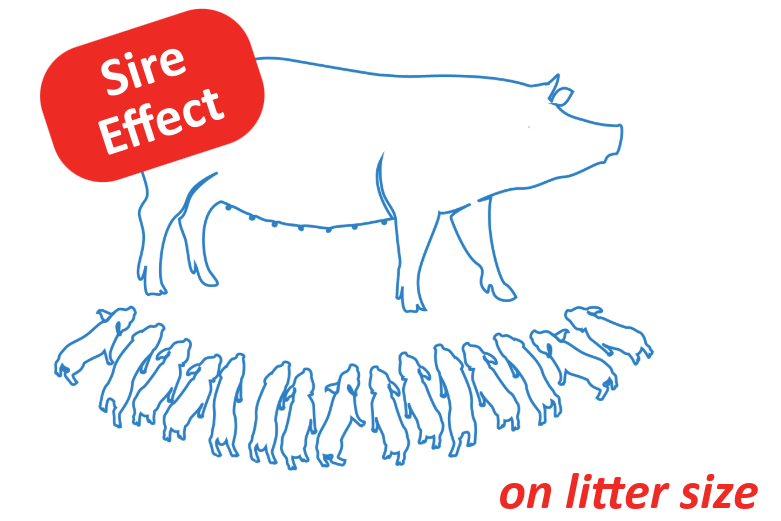
New traits can add further value. One example is the service sire effect on litter size. The boar’s contribution is much smaller than the sow’s, but large, well-connected datasets can identify sire families with consistently favourable or unfavourable effects.
Many small improvements, accumulated over generations, create measurable commercial progress.

Sustainability through biological efficiency
Sustainability is not separate from performance. It is one result of more efficient biology.
Pigs that grow efficiently, use less feed, survive to market and produce more saleable meat make better use of feed, water, housing, energy and labour.
A European life-cycle assessment found that full-programme PIC genetics – maternal and terminal combined – were associated with 7.7% lower greenhouse-gas emissions than the European industry comparison.
Genetics is not the only sustainability tool. Feed sourcing, health, energy use and farm management remain important. But genetic progress creates a cumulative advantage that is passed from one generation to the next.
Genetic Carbon – for greater sustainability in pork production
The programme behind the product
A terminal sire is the visible result of a much larger system.
Behind him are breeding populations, selection objectives, health standards, genomic information, commercial data, digital technologies and the people who connect every stage.
A competitive terminal sire portfolio is therefore not defined by the breadth of its product range, which meets the varying needs of pig farmers.
It is defined by whether the programme behind those products can respond to different market needs, improve several traits at the same time and deliver genetic progress reliably to commercial farms.
Because the key question is not only which sire is used today.
It is whether the programme behind him is already preparing for tomorrow.